Symptoms point to specific parts, and naming them up front saves you money. A motor that runs for a few seconds with the door sitting still usually means a stripped nylon drive gear inside a chain-drive head — common…
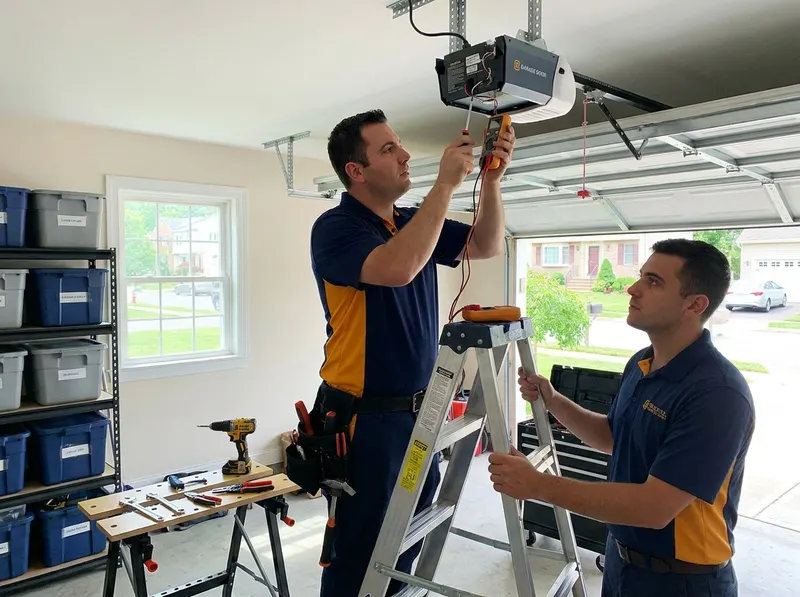
Symptoms point to specific parts, and naming them up front saves you money. A motor that runs for a few seconds with the door sitting still usually means a stripped nylon drive gear inside a chain-drive head — common on 15-to-20-year-old Chamberlain, LiftMaster and Genie units in the older detached garages along Park Street and Grand Street. A single click and a dead motor points to a failed starting capacitor. Nothing at all from the wall button, no light, no click? That is typically the logic board or the low-voltage wire run, which corrodes at the staples in damp garages. A door that starts down and reverses back up almost always traces to the photo-eye sensors 6 inches off the floor — knocked out of alignment by a bike tire, or blinded by low afternoon sun coming through an open door facing the Little Ferry Circle at Route 46.
Repair versus replace is a real decision, not a sales script. We repair when the motor and gearbox are sound and the failure is one part — gear kit, capacitor, sensor pair, trolley, chain or belt, limit switch. We recommend replacement when the head is a pre-2000 unit with no rolling-code security, when the board and the gear set are both failed (the parts total approaches the price of a new opener), or when the housing itself has corroded from the inside out. That last case shows up in the Little Ferry flood belt — homes near Losen Slote Creek, along Marginal Road at the Hackensack riverfront edge, and on the west marsh side toward the Meadowlands wetlands, where standing water and years of humidity leave green crust on the terminal screws and rust on the rail. A ceiling-mounted head that took splash damage can be repaired temporarily, but we will tell you plainly when it is on borrowed time.
One diagnostic step matters more than any part swap: the opener is a motor, not a lifting machine. If the torsion spring is weak or a cable has slipped its drum, the opener overworks, strips gears, and burns boards — replacing the gear kit without correcting the balance just breaks the new gear. So we pull the emergency release, lift the door by hand, and see whether it stays put at waist height. If the door is heavy or crooked, the fix belongs to the spring and cable system, and we say so instead of selling you an opener you do not need.
Commercial and mixed-use buildings get the same approach. The Redneck Avenue industrial district and the shops along the Main Street business district and Bergen Turnpike corridor tend to run heavier jackshaft or trolley units on wider openings, where the usual culprits are worn trolleys, stretched chains, misaligned floor-level sensors in a busy loading area, and open-close cycles gone out of limit range. Homes in the Washington Avenue / Memorial School area and the Liberty Street blocks near Borough Hall are mostly 1950s-era garages with low headroom, where sensor brackets and rail hardware take a beating from tight parking. The truck carries the parts these repairs usually call for — gear and sprocket kits, capacitors, safety sensor sets, trolleys, chains, belts, remotes and keypads — so most Little Ferry opener calls finish the same day the diagnosis happens. Door stuck? We diagnose, price, fix.
Every job gets a firm, written price after a free on-site visit.
Tell us about your garage door opener repair job in Little Ferry and we'll send a clear, written quote — usually the same day.
 Span Garage Door's Repair Experts