Track damage announces itself in a specific way. A door that runs smooth for two feet then jerks and shudders usually has a bent or dented vertical track section, often from a bumper tap in one of the narrow single-car…
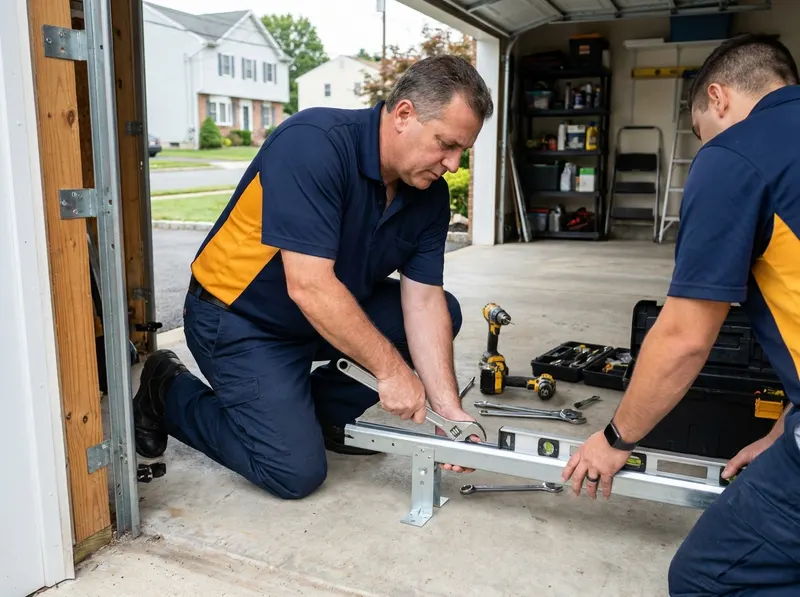
Track damage announces itself in a specific way. A door that runs smooth for two feet then jerks and shudders usually has a bent or dented vertical track section, often from a bumper tap in one of the narrow single-car garages on the Liberty Street and Park Street blocks. A door that leans in the opening, with one side leading the other, is a plumb problem — the vertical track has drifted because a jamb bracket lag has pulled loose from soft or rotted wood. A door that jumped the track entirely and is now wedged at an angle needs the load taken off, the rollers reseated, and the track re-aligned before anything is powered again. Never run an opener against a door that is off-track — that is how a bent track becomes a bent section and a torn bracket.
The decision that matters is repair versus replace the track. Straightening and re-anchoring is the right call when the steel is dented or spread but not creased, and when the jamb still has sound material to bite into. Full track section replacement is the right call when the flange is kinked, when the radius on the horizontal curve is crushed, or when the bottom 12 to 18 inches have rusted thin — a pattern we see constantly on the Losen Slote Creek marsh side, along Marginal Road at the Hackensack riverfront edge, and in the low-lying garages near Mehrhof Pond, where water sat against the bottom of the door and ate the track from the inside out. Replacing one bad section costs less than fighting a door that will bind again in six weeks, and it is far cheaper than a full door. Bent tracks are a repair, not automatically a new door.
Brackets are the quiet half of this job. Jamb brackets fastened into 1940s-era studs or into the softened wood typical of Bergen County flood-belt homes will loosen, and once one bracket shifts the whole track goes out of plumb, which loads the rollers sideways and chews cables and hinges. The fix is backing block or fresh solid material, correct-length lags, and re-shimming so the track sits square and evenly spaced from the door face top to bottom. Overhead, the rear hang brackets and angle iron matter just as much — sagging perforated strap on a wide door lets the horizontal track drop, and the door starts scraping at full open. On the wider commercial and warehouse doors around the Redneck Avenue district and off the Bergen Turnpike corridor, that hardware is heavier gauge and the anchoring has to be into structure, not just sheathing.
We carry standard residential track sections, jamb and flag brackets, rollers, hinges and lag hardware on the truck, which is why most Little Ferry track calls finish the same visit rather than turning into a parts-order wait. If the diagnosis turns out to be something other than track — a snapped cable letting one side drop, a drum that slipped, or a spring that no longer holds the door — we tell you that on the spot and price the actual repair instead of selling you track you do not need. Doors near the Little Ferry Circle at Route 46 and the Washington Avenue blocks by Memorial School see heavy daily cycles, and on those we check the whole run rather than just the damaged foot of steel.
Every job gets a firm, written price after a free on-site visit.
Tell us about your track repair and bracket reset job in Little Ferry and we'll send a clear, written quote — usually the same day.
 Span Garage Door's Repair Experts