Rollers, hinges and bearings are the cheapest hardware on a garage door and the most common reason a door that "still works" feels like it's about to fail. The symptom map is fairly reliable: a rhythmic squeal or…
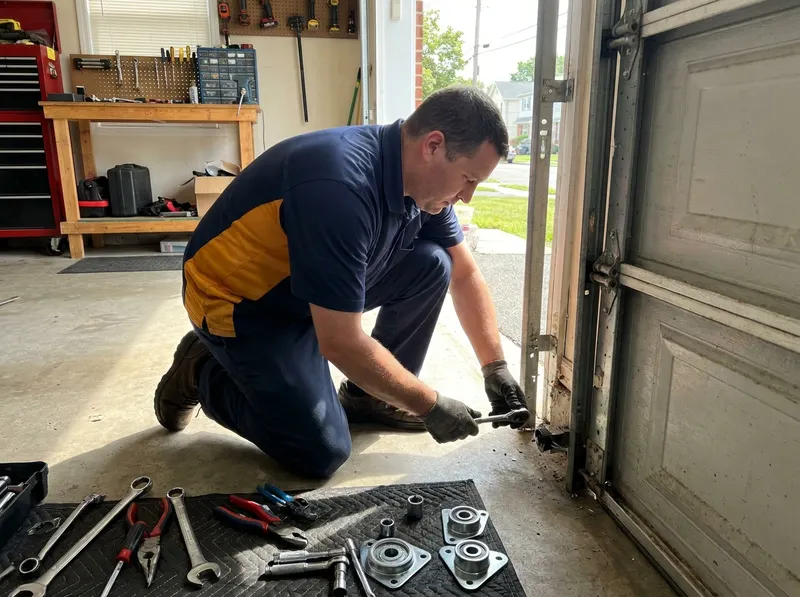
Rollers, hinges and bearings are the cheapest hardware on a garage door and the most common reason a door that "still works" feels like it's about to fail. The symptom map is fairly reliable: a rhythmic squeal or grinding that gets louder as the door speeds up usually means dry or flat-spotted rollers; a metallic knock at one point in the travel is often a cracked hinge letting a section shift; a high whine or chirp from above the door, centered over the shaft, points at the center bearing or an end bearing plate running dry. Wobble at the top section with the rest of the door tracking straight is typically the top-fixture roller. Naming the symptom on the phone lets us load the right parts before we roll.
Little Ferry hardware wears differently than hardware ten miles inland, and it's the water and the salt. Homes on the Losen Slote Creek west marsh side and along the Marginal Road edge near the Hackensack riverfront sit in damp, low-lying air most of the year, and doors that have taken flood water carry rust in the bottom section — the #1 hinges and the bottom roller brackets go first. Around the Little Ferry Circle at Route 46 and the Bergen Turnpike corridor, winter road salt gets tracked into the garage on tires and eats the roller stems and hinge pins from the inside out. Older houses on the Park Street and Grand Street blocks and near Memorial School often still have the original unsealed steel rollers, which are noisy by design and grind their stems oval after a decade. On Redneck Avenue and in the Main Street business district, the driver is cycle count, not corrosion: a warehouse or shop door opening thirty times a day burns through rollers and bearings in a fraction of the time a home door does.
When this repair is the right call versus something bigger: hardware replacement makes sense when the door panels are structurally sound, the springs are intact, and the complaint is noise, roughness, or binding. It's a maintenance-class repair with a long payoff — new nylon rollers and fresh bearings reduce drag on the whole system, which means the opener pulls easier and the springs and cables aren't fighting friction on every cycle. The honest trade-off: if bottom sections are rusted through, jambs are rotted, or multiple panels are creased, replacing hardware on a failing door only buys time, and we'll say so instead of selling you rollers. Similarly, if the door dropped with a bang and is now dangerously heavy, that's a torsion spring problem, not a roller problem — don't operate it, call us.
On roller choice, there's a real decision. Sealed nylon rollers with steel ball bearings are the standard upgrade for houses: they're markedly quieter, they don't shed metal dust into the track, and they suit attached garages under bedrooms — common on the Washington Avenue and Liberty Street blocks. Heavy-duty steel rollers with larger stems still make sense on wide commercial and insulated doors carrying real weight in the Redneck Avenue industrial district. We also check that hinge numbers match their positions, because mixed or wrong-numbered hinges force sections out of plane and chew rollers again in a year. Every quote is a ballpark until we see the door; the exact number is confirmed on-site, in writing, before anything is unbolted.
Every job gets a firm, written price after a free on-site visit.
Tell us about your roller, hinge and bearing replacement job in Little Ferry and we'll send a clear, written quote — usually the same day.
 Span Garage Door's Repair Experts