Sensor faults split into two groups, and the difference decides the repair. An alignment or line-of-sight fault means the beam is being broken or missed: a bracket knocked loose by a snowblower or bike tire, a sensor…
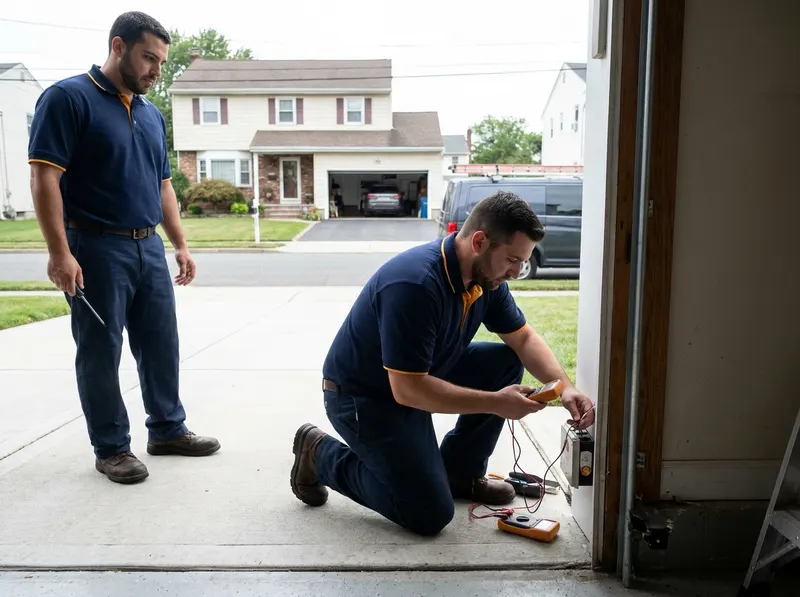
Sensor faults split into two groups, and the difference decides the repair. An alignment or line-of-sight fault means the beam is being broken or missed: a bracket knocked loose by a snowblower or bike tire, a sensor rotated a few degrees, a west-facing door where late-afternoon sun washes out the receiver, or dust and cobwebs over the lens in a Redneck Avenue industrial bay. A wiring fault means the beam never gets power or signal: staples driven through the low-voltage wire during a wall or ceiling project, a corroded splice, or a chewed run behind stored bins. Alignment problems usually show one sensor LED out or flickering. Wiring problems usually kill both, and the opener answers by refusing to close and blinking its overhead light.
Little Ferry geography matters here more than on most repairs, because photo eyes sit roughly four to six inches off the slab — the exact zone that gets wet. On the Losen Slote Creek west marsh side, along Marginal Road at the Hackensack riverfront edge, and around the low blocks near Mehrhof Pond, we see rusted sensor brackets, green corrosion on terminal screws, and wire runs stapled to a damp bottom plate. Road salt tracked in off the Little Ferry Circle at Route 46 and the Bergen Turnpike corridor accelerates it. On Park Street and Grand Street and the Washington Avenue / Memorial School blocks, older detached garages often have the original 1990s sensor pair on a newer opener, and brittle insulation is the real culprit rather than the eyes themselves.
The other half of auto-reverse has nothing to do with the sensors. Openers built for the U.S. market since 1993 are required to carry two forms of entrapment protection, and the second one is force-based: the opener senses resistance and reverses. That system throws the same symptom — a door that closes most of the way, hits the floor, then rides back up. The cause is often mechanical, not electronic. A binding roller, a flat spot in a track, a spring losing tension, or a travel limit set too far past the floor makes the opener think it struck a car bumper. Turning up the force to "fix" it is the wrong move: it defeats the protection that stops a closing door on a child or pet. We correct the mechanical drag and reset limits and force to the manufacturer's range instead.
When does sensor work fit versus a full opener replacement? If the motor runs, the door travels, and the fault is limited to eyes, brackets, wiring, or settings, repair is the clear call — parts are inexpensive and the unit keeps its remaining service life. Replacement makes sense when the logic board itself has failed on a chain-drive unit well past fifteen years, where a board can approach the cost of a new opener with a fresh warranty and current sensor hardware. We say which one you're looking at before you decide, and we test the finished door with a 2x4 laid flat under it — the standard reversal check any Little Ferry homeowner can repeat afterward.
Every job gets a firm, written price after a free on-site visit.
Tell us about your safety sensor and auto-reverse repair job in Little Ferry and we'll send a clear, written quote — usually the same day.
 Span Garage Door's Repair Experts