A snapped cable is a tension problem, not a lifting problem, which is why do-it-yourself attempts go badly. The cable is only the visible casualty — the real question is why it failed. Fraying at the bottom loop points…
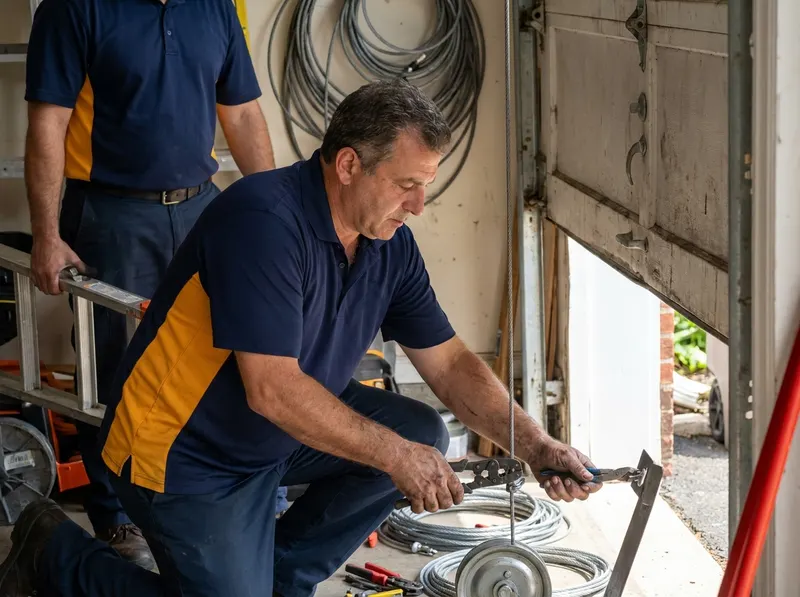
A snapped cable is a tension problem, not a lifting problem, which is why do-it-yourself attempts go badly. The cable is only the visible casualty — the real question is why it failed. Fraying at the bottom loop points to rust and salt splash. A cable that unspooled cleanly off the drum usually means the drum set screws slipped on the shaft or the door hit an obstruction and lost tension on one side. A cable that shredded mid-span often rode over a burr in the flattened lower track. Replacing the cable without correcting the cause guarantees a repeat failure within a season or two. That diagnosis is the first thing done on arrival, and it gets explained out loud, in plain terms, before pricing.
Little Ferry is hard on cables in a specific way. Homes on the Marginal Road and Hackensack riverfront edge, the blocks backing onto Losen Slote Creek and the west marsh side, and the low-lying stretches near Mehrhof Pond sit in damp air year-round, and garage floors in that flood belt hold moisture against the bottom bracket where the cable loops on. Rust seizes the bottom bracket bolt first, then works up the cable strands — so a cable job on those streets frequently includes a corroded bracket that has to come off with heat or be cut, not just unbolted. Along the Bergen Turnpike corridor and near Little Ferry Circle at Route 46, winter road-salt spray carried into open garages accelerates the same wear. Doors on Park Street, Grand Street and the Liberty Street blocks that get cycled six or eight times a day simply reach cable fatigue sooner than a low-use door.
When a cable snaps, the choice is cable-only repair versus a fuller rebuild, and the trade-off is honest to lay out. Cable-only replacement fits when the drums are true, the tracks are undented, the springs still hold tension and the second cable shows no fraying — that is the fast, lower-cost path and it is the right call on most doors under about twelve years old. A rebuild makes more sense when the inspection turns up a snapped cable alongside a tired torsion spring, an out-of-round drum, or bottom sections rusted through at the cable anchor. Paying twice for two trips costs more than doing both at once, and the crew will say plainly which category your door is in rather than upselling by default. If the spring is what actually failed and the cable just came off the drum as a result, that is a different repair and gets priced as such.
Commercial doors in the Redneck Avenue industrial district and the shops along the Main Street business district use heavier cable, larger drums and sometimes high-lift drum sets, so those jobs run longer and cost more than a residential single door. Never operate the opener on a door with a broken cable. One side is unsupported, the door can jam hard in the track or drop, and a forced cycle turns a cable repair into a bent-section repair. Pull the manual release, leave the door where it sits, and call. If a vehicle is trapped behind it, say so on the phone — that moves the call up. Free on-site visit, price confirmed before work, and the door gets balance-tested by hand at the end so you can see it holds position on its own.
Every job gets a firm, written price after a free on-site visit.
Tell us about your snapped lift cable repair job in Little Ferry and we'll send a clear, written quote — usually the same day.
 Span Garage Door's Repair Experts